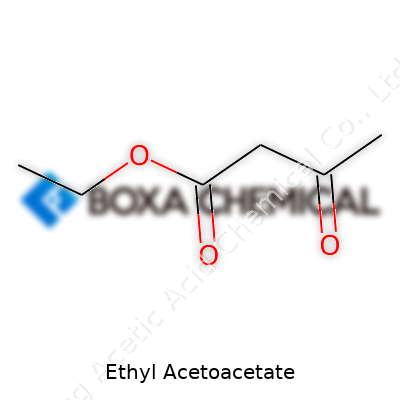
Since the late 1800s, chemists have known ethyl acetoacetate as more than just an obscure chemical. This compound first appeared on the scene through the ingenuity of German chemist Anton Geuther. It quickly became essential to several milestones in organic chemistry, largely thanks to its clear reactivity and utility as a synthetic building block. My first encounter with ethyl acetoacetate brought a sense of respect for the researchers who, over decades, kept pushing its boundaries. The influence of this compound feels like a bridge between foundational chemistry and so many modern advances, especially as its derivatives opened doors to countless families of compounds.
Ethyl acetoacetate stands as one of those workhorse reagents in many labs. Chemists know it by its distinctive fruity smell, a result of its enol form in equilibrium with the keto form. The clear, pale-yellow liquid has found a stubborn presence in pharmaceutical, agricultural, and dye industries. Commercial grades usually offer purity levels fit for both industrial and laboratory work. The substance attracts attention not just from synthetic chemists crafting new molecules, but also from paint manufacturers, flavoring agents, and even as a solvent in the cosmetics industry.
This compound boils near 180°C, mixes well with most common organic solvents, and carries a density just above water. It’s flammable, prompting extra care in handling and storage. Solubility in water stays limited due to its dual nature, but its polar and non-polar characteristics benefit formulation scientists reaching for flexibility in processes. Its acidic alpha hydrogen makes it special in reactions, allowing the molecule to form enolates and support nucleophilic attacks under mild conditions—qualities I’ve seen leveraged in countless lab protocols and industrial setups alike.
Manufacturers supply ethyl acetoacetate in sealed steel drums, amber glass bottles, or chemical-resistant plastic to protect it from air and light, which could trigger unwanted decomposition. Labels always warn of flammability and list concentrations of potential impurities after distillation. Product sheets might highlight relevant hazard classifications and regulatory identifiers. Even after years of handling, I never skip reading updated labels; proper identification matters for safety and compliance in every setting.
The classical approach to producing ethyl acetoacetate goes through the Claisen condensation, a familiar undergraduate chemistry experiment. Ethyl acetate reacts with sodium ethoxide, forming the sodium salt of ethyl acetoacetate, which later gets acidified to yield the target compound. Industrial operations employ this method at greater scale, often optimizing for yield and purity based on downstream needs. The technology endures because the basic chemistry remains robust and adaptable, even as process controls and sustainability pressures shape modern production lines.
Ethyl acetoacetate participates in a remarkable range of transformations. Alkylation and acylation at the active methylene position produce a variety of valuable intermediates. Chemists learned to exploit its tautomerism and use it as a precursor to heterocycles, amino acids, and pharmacologically active molecules. Its reactivity doesn’t just power synthesis; it teaches students about acidity, resonance, and reactivity in organic chemistry, making it both a tool and a tutorial all at once.
Ethyl acetoacetate answers to many titles—acetoacetic acid ethyl ester, ethyl 3-oxobutanoate, and EAA among them. These aliases permeate research articles and procurement catalogs alike, often dictated by tradition or industry standards. While these might seem like trivial variations, familiarity with all forms helps avoid confusion and mistakes, especially in multidisciplinary teams or global markets where translation hurdles still pop up.
Practical chemistry expects respect for the hazards inherent to every substance, and ethyl acetoacetate sits firmly in the category of chemicals needing deliberate care. Its flammability calls for strict adherence to no-open-flames policies and continuous ventilation in workspaces. Personal protective equipment—gloves, goggles, lab coats—should never become negotiable. Regulatory bodies publish limits for airborne exposure, and disposal requires careful segregation from incompatible waste streams. I’ve seen lost productivity and real health risks wherever diligence in these areas falters. Safety takes constant vigilance, not just better rules.
Ethyl acetoacetate shows up in diverse sectors. Pharmaceutical research relies on its role in crafting barbiturates, antimalarials, and other APIs. Dye manufacturers count on its potential for producing long-lasting colorants. Even the food industry taps into its fruity aroma when blending complex flavors and fragrances. In the coatings industry, its solvent and plasticizer abilities improve surface finishes and flexibility. This broad reach gives the compound relevance to businesses large and small, making ongoing supply and regulatory compliance a shared concern across all involved chains.
Every year, journal articles reveal new twists in how this compound gets used, from advanced polymer chemistry to innovative preparation of functional materials. Research groups keep testing greener synthesis routes and more effective catalytic processes, aiming to trim waste, energy use, or both. Any step forward has to face old trade-offs: purity versus cost, speed versus selectivity, and process scalability. These questions draw diverse fields together—academic labs, industry R&D centers, and environmental scientists—to debate, challenge, and strengthen the chemical’s role in the future.
No chemical escapes scrutiny, and ethyl acetoacetate is no exception. Toxicological studies test its effects on living systems, with data pointing to low acute toxicity yet real eye and skin irritancy. Absorption through skin or lungs can cause central nervous system depression at high exposure levels. Modern work environments aim for engineered controls to keep concentrations far below thresholds set by international health agencies. Handling protocols reflect lessons learned through decades of accident reports and occupational studies—reminding us that no familiarity excuses shortcuts in lab or plant.
Looking ahead, ethyl acetoacetate seems primed to shape even more sectors as industries chase sustainability, efficiency, and innovation. Enhanced catalytic methods, bio-based feedstocks, and circular chemistry principles might soon reduce the environmental impact of traditional processes. New applications in material science, especially biodegradable polymers or advanced drug discovery, depend on the continued adaptability of this old but reliable compound. The story of ethyl acetoacetate hasn’t passed its prime—if anything, the next chapters may hold as much promise as the early discoveries that put it on the map.
Almost every day, people interact with products shaped by chemicals like ethyl acetoacetate, even if they’ve never seen the name on a label. A less flashy name doesn’t take away from its importance in manufacturing, research, and even some food flavors. Curious minds might want to know why a single chemical keeps finding its way into so many products. From what I’ve seen, its versatility matches its mouthful of a name.
Ethyl acetoacetate acts as a building block in the creation of flavors in food and beverages. It brings fruity and buttery notes to candies and pastries. In the fragrance world, it sits at the starting line for perfumes, helping chemists build more complex aroma compounds. This work doesn’t always get the spotlight, but people notice when a perfume smells off or a sweet doesn’t hit the right notes. Its presence makes a real difference.
Dig deeper into pharmaceuticals and you’ll see ethyl acetoacetate pulling heavy weight. Medication research often relies on this compound to create molecules for drug tests. Antibiotics, painkillers, and even some treatments for heart conditions have roots that trace back to it. Factories also count on it to help produce agricultural chemicals and dyes. I’ve talked to chemists chasing new medicines and pigments, and almost all know ethyl acetoacetate as a familiar friend.
Many paints and coatings, especially those used for durability or special finishes, owe their effectiveness to this compound. It helps make lacquers tough enough for housewares and helps adhesives stick longer. In practical terms, this means furniture and fixtures last longer and resist everyday wear and tear. There’s satisfaction in knowing that a kitchen table still looks good after years of hard use, a detail that traces back to chemistry.
While its uses span many industries, the conversation can’t ignore safety. Like other chemicals, improper handling in factories or labs risks harming workers or the environment. Air quality and disposal practices matter. Government agencies such as the Environmental Protection Agency and organizations like the European Chemicals Agency keep a close watch, setting limits and guiding safe use. As someone who’s worked in labs, I’ve seen that practical training and strict protocols—like good ventilation and waste tracking—reduce risks.
Manufacturers could benefit from more investment in greener production processes. Advances in waste reduction and recycling promise cost savings and lower environmental footprints. Developing alternative methods that lower reliance on harmful solvents or reduce hazardous by-products could also protect communities. It takes ongoing commitment, not shortcuts.
People making decisions about what goes into products—from paint to pills—should keep asking tough questions. Is every step as safe and sustainable as it could be? Consumers and advocacy groups have a role, too, by pushing for clear labeling and responsible sourcing. The more people know about what’s behind their products, the more likely companies are to care about doing better.
Ethyl acetoacetate carries a formula most people forget after high school: C6H10O3. To me, it’s more than just a bunch of letters and numbers. This molecule opens doors in labs and factories. It's got a certain simplicity, yet the world depends on this simple compound in ways most folks never think about.
Back during my undergraduate days, ethyl acetoacetate kept showing up in organic lab. It serves as a backbone for creating dyes, pharmaceuticals, and flavors. No scientific hype required—kids’ crayons and painkillers have both relied on derivatives of this little ester. That versatility comes directly from how those numbers and letters line up: two carbonyl groups mixed with an ethyl tail, forming a neat bridge between acids and ketones.
The industries that power daily life tap into this beauty. Pharmaceuticals, just for one, pull from C6H10O3 to build medications—think pain relievers and fever reducers. In the world of flavors and perfumes, chemists tweak this molecule to make scents and tastes punch through stronger. It’s a quiet hero behind shelves at grocery stores and pharmacies.
Some will say that knowledge of chemical formulas is for chemists. But the spread of misinformation in recent years taught me something: basic science facts shape what folks trust and believe. Understanding simple structures, like that formula, steps over nonsense claims and fear-mongering. With just C6H10O3 on hand, anyone can use a reference point if sensational headlines pop up about chemicals in food, fragrance, or medicine.
Chemists also need to know their building blocks before reaching for fancy new reactions. With ethyl acetoacetate, you get reactions like the Claisen condensation. This isn’t just academic stuff—it guides companies through making better, safer ingredients every year. Laying the foundation with the right formulas lets experimentation stay grounded and, just as important, safer for workers and communities.
Production and handling can't ignore safety. I toured a chemical plant a few years back and saw firsthand how easily spills or contamination can happen if corners get cut. Pure ethyl acetoacetate evaporates quickly—a flammable liquid if storage slips or someone ignores the safety sheet. Factories train their people rigorously, but accidents still can happen if leadership slacks off or skips investments in updated gear.
It's up to regulatory bodies and the companies to educate, monitor, and keep folks informed about both risks and best practices. Keeping that chemical formula handy marks the start of understanding what’s inside a drum, not the end. Transparency about composition, hazards, and proper disposal stands as the real line between responsible stewardship and reckless behavior.
More students deserve hands-on chemistry experiences, not just lessons out of a textbook. Whenever I explain C6H10O3 in plain language—no gloss, no jargon—people pay attention. That basic science literacy paves the way to smarter choices, both at the kitchen table and the factory floor. Anyone gripping about "dangerous chemicals" forgets that robust knowledge turns fear into understanding, every time.
Working in a busy lab or warehouse, a lot of us get used to handling all sorts of chemicals every day. Ethyl acetoacetate might not sound like a big deal—used for making dyes, pharmaceuticals, and flavors—but its storage isn’t something to handle on autopilot. Years back, I learned this firsthand after a sticky mess and a week’s lost productivity taught me that leaving it near the cleaning sink was a rookie mistake.
Ethyl acetoacetate reacts with water, forming acetic acid and ethanol. Moisture in the air can trigger this reaction, so you keep it in a tight container, not just to meet regulations, but to preserve your batch. In my experience, that always means using glass or metal containers with snug lids to keep out humidity. Some storage rooms run small dehumidifiers for this very reason—the work, and the product, really do last longer that way.
Heat changes the game. This stuff boils around 180°C but the bigger risk for most workplaces comes from flammable vapor. I’ve seen stored drums stacked right next to power cabinets and heaters, an obvious recipe for disaster. Labs and warehouses both use flammables storage cabinets, which stay cool and shut tight if fire breaks out. I’ve never forgotten the smell of burned plastic from a fire that started near a poorly stored solvent—you don’t want to see that up close.
It’s no surprise that regulations push for cool, shaded storage, away from direct sunlight and any heat sources. This helps prevent vapor buildup inside the container. In small labs, even storing near a sunny window can drive up the risks. Flammable storage isn’t about ticking off boxes. It’s a safety routine, and lives can depend on simple planning like labeling and keeping containers away from stray sparks or static discharge.
Some folks store everything in the same cabinet, but mixing acids, bases, and oxidizers together with ethyl acetoacetate never turns out well. One splash or vapor mix can trigger unwanted reactions, especially with oxidizers. As tempting as it is to save space, putting incompatible chemicals together leaves you fixing leaks instead of getting real work done. At more than one job, I’ve labeled shelves not to please the safety manager, but to keep coworkers and myself safe.
If you don’t remember when you opened a bottle, odds are good you’re not alone. Every opened bottle starts to degrade, even under good storage. Expiry dates and proper labeling have saved labs I’ve worked in from making costly mistakes with spoiled or degraded chemicals. It’s simple: write the date you first opened the container, and toss it when it starts to look or smell off. Ethyl acetoacetate grows cloudy and gives off a stale odor once water or air gets in.
Safer storage pays dividends. It saves time, cuts down waste, and gives peace of mind. Most problems I’ve seen crop up from shortcuts or clutter—fixing those doesn’t mean investing in new tech, just being habitually careful. For ethyl acetoacetate, it’s about clean, dry, and cool storage with a little extra vigilance around open flames and potential leaks. That’s where real safety and real quality intersect, and it’s worth getting right every single time.
Ethyl acetoacetate shows up behind the scenes in many factories, labs, and even in the flavors added to everyday foods. At first glance, the name sounds intimidating, almost like something better left in the lab under lock and key. Yet many chemists and workers cross paths with it without thinking twice. But does familiarity make it safe? Not always. I've spent years handling chemicals with names that twist the tongue, and I learned the hard way that you can't judge a hazard just by a label's tone or a history of near misses gone right.
Some see ethyl acetoacetate as a workhorse. The paint industry relies on it to make colors shine. Pharmaceuticals use it as a building block, and the food world taps into it for its fruity note, albeit in very tiny amounts. This all points to a certain level of comfort. Yet, stories from workers who have had headaches or felt dizzy during a spill tell a different tale. Breathing in its vapors can irritate the throat and nose. Spills on bare skin sting. Eyes start to water after a splash. It reminds me of painting a room with poor ventilation, only to find a pounding headache by late afternoon. Short exposures tend to pass, but the discomfort is real.
Looking at what science says, ethyl acetoacetate does not stack up among the worst toxins. Drinking significant amounts causes nausea, and it can lead to vomiting. Rats exposed to high doses for weeks lost weight and became less active. I wouldn’t want to test the limits myself. Long-term damage—say to organs or genes—has not been clearly shown after typical workplace doses. Yet the fact that it irritates, gets absorbed through skin, and gives off flammable fumes means treating it casually is risky. Workers deserve protection, not just luck or assumptions that “it’s probably fine because we’ve always used it.” The right to a safe workplace applies equally in chemical plants, schools, and small workshops.
In the US and Europe, exposure standards exist, even if they’re not as strict as those for proven cancer-causing agents. Treatments for accidental contact focus mainly on washing away the chemical or moving to fresh air. Proper gear—gloves, goggles, masks—goes a long way. In my experience, training and culture count as much as rules. I’ve seen factories post safety data on every wall, while others downplay risks to keep production humming along. Cutting corners for speed or savings almost always leads to regrettable outcomes. Safety is a habit, not a one-time lecture.
Stories about exposure to ethyl acetoacetate mostly revolve around minor burns, coughing, and brief discomfort. We can’t ignore the potential for serious incidents though, especially where storage is poor or exhaust fans fail. Replacing open vats with closed systems, wearing the right gloves, and fixing leaks without delay all beat hoping for the best. There’s value in treating every chemical with respect, even if nobody landed in the hospital last shift. The people who handle these substances every day notice big differences when employers invest a little extra time and money into solid safety programs. It’s not about fear—it’s about being able to go home healthy every day.
Ethyl acetoacetate holds a steady spot in most labs that deal with organic synthesis. Every time I’ve worked with it, I’m reminded of how easily overlooked its shelf life can be. Folks tend to think most chemicals last forever on the stockroom shelf, especially something so common. Truth is, this liquid doesn’t thrive in neglect.
Storing ethyl acetoacetate the right way matters a lot. Most bottles out there carry a shelf life marker—usually two years from the date of manufacture when kept tightly closed, away from sunlight, at room temperature. That two-year figure is not a marketing ploy. The compound breaks down slowly even with the best care because oxygen and moisture always find their way in. Left open on the bench, you’ll smell the difference before you see much change. That fruity, sharp scent fades as the liquid picks up water and starts to hydrolyze.
I’ve lost count of the times someone handed me a cloudy bottle pulled from a forgotten corner. Once ethyl acetoacetate absorbs enough water vapor, side reactions creep in, forming acetic acid and other byproducts. Reactions that should hum along with fresh stock start to stall. You don’t get predictable yields, and purity slips. This matters for anyone doing research or formulating paints, dyes, or pharmaceuticals that depend on consistency. The chemical industry runs on reliability; starting with degraded stock makes for headaches, failed batches, and wasted time.
Manufacturers include best-by dates for a reason. Those labels give you a window where you can count on the contents performing as expected. After that date, nothing catastrophic happens, but the odds of poor results climb. Labs that ignore these dates end up troubleshooting mysterious problems that trace back to bad stock. Small operations might be tempted to stretch a bottle past its listed shelf life, yet few realize that slight chemical changes throw off results weeks or months before anything visible appears.
A lot of people look for shortcuts, thinking they’ll just use up borderline material until it’s gone. From personal experience, I’d argue that it pays to stick to documented shelf life. Analytical checks such as thin-layer chromatography or gas chromatography tell the real story. If you spot extra spots or peaks, it’s time to trade that old bottle for fresh. Just one impure run can spook anyone counting on reproducible chemistry. Analytical checks don’t take long, and confidence matters more than pinching pennies.
Good storage practices stretch the working life of most chemicals. Tuck ethyl acetoacetate away from light, seal caps tightly, and keep humidity out. Some labs add a little desiccant to storage cabinets or use small bottles to reduce the number of times a container gets opened. These habits save headaches down the road. Clean labels with purchase dates make it easy to rotate stock and avoid confusion. Regular audits clear out expired materials before they become a problem.
Nobody wants to explain a failed experiment or a rejected batch that came down to stale ingredients. Ethyl acetoacetate isn’t expensive, but the results that depend on it sure are. Paying attention to shelf life saves money, reputations, and time. It’s the kind of habit that never seems urgent—until it suddenly is.